We nearly drove past it.
St Gregory’s Minster sits in Kirkdale, a quiet valley between Kirkbymoorside and Helmsley. There are no shops gathered around it and no village street leading up to the door. Just the church, its graveyard and the wooded slope behind it.
Patricia spotted the sign. I was looking for somewhere to turn around.
We had come to see a sundial. Not normally something that would justify a special journey, but this one has been above the church door for nearly a thousand years.
That changes things.
A church hidden in Kirkdale
The road into Kirkdale feels increasingly narrow as you approach the church. By the time we parked, it was difficult to imagine that this secluded place had once been an important religious centre for the surrounding settlements.
Bertie immediately set off towards the graveyard with the confidence of a dog who had been appointed official inspector.
The church itself is low, stone-built and more complicated than it first appears. Different centuries have left different pieces behind. There is an old nave, a later aisle and a tower that looks medieval but was actually added in the nineteenth century.
The real reason for our visit was waiting inside the porch.
The sundial above the door
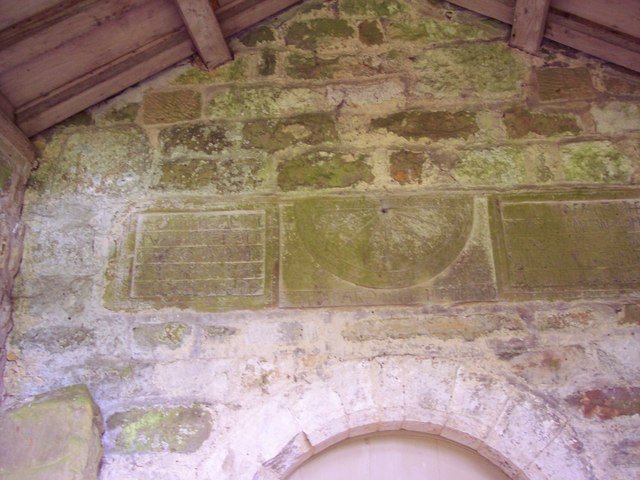
The Kirkdale sundial is carved into a long stone panel above the church entrance. The dial occupies the centre with inscriptions running across the stones on either side.
There is no pointer now. The original gnomon has disappeared, but the lines of the dial are still clearly visible.
This was not intended to divide the day into precise modern hours. It marked the stages of the day when services and prayers took place. The inscription describes it as the day’s sun marker “at every tide”.
The word “tide” meant a portion of time. It survives in expressions such as Yuletide, although I cannot remember the last time I heard anyone use it while checking whether the shops were still open.
Patricia stood beneath the dial trying to follow the carved lettering. I could make out almost none of it.
“It’s Old English,” she said.
That made me feel slightly better.
A message from before the Norman Conquest
The inscription tells us that Orm, the son of Gamal, bought St Gregory’s Minster when it was ruined and had it rebuilt from the ground.
It also names Edward as king and Tostig as earl. That places the rebuilding between 1055 and 1065, during the reign of Edward the Confessor and immediately before the Norman Conquest.
This is what makes the stone remarkable. It is not a later memorial trying to reconstruct what might have happened. It is a message left by the people who paid for and carried out the work.
Orm and Gamal are Scandinavian names, a reminder of the Viking settlement of this part of Yorkshire. Yet the inscription is written in Old English. The stone captures a part of Yorkshire where cultures had mixed together long before anyone thought to describe the process in a museum.
Another line names Hawarth and Brand, the people associated with making the sundial. Their names remain over the doorway almost a thousand years later.
Most of us struggle to leave clear instructions for the person reading the electricity meter.
How the sundial survived
The stone is in surprisingly good condition. That is partly because it spent several centuries hidden beneath plaster.
It was uncovered in 1771 when work was being carried out on the porch. Once revealed, the porch helped protect it from the North Yorkshire weather.
Without that accident of concealment, the inscription might have become impossible to read. Its survival seems even less likely when you stand beneath it and see how exposed the church would once have been.
The sundial is now recognised as one of the most important surviving Anglo-Saxon inscriptions in England. St Gregory’s Minster itself is Grade I listed. Historic England’s official listing records both the sundial and several older features preserved inside the church.
Inside St Gregory’s Minster
The sundial tends to receive most of the attention, but the interior deserves time too.
The church contains two Saxon grave slabs and a thirteenth-century font. Stone benches remain along the walls and the narrow western arch is part of the earlier building. There are medieval bells above and fragments of carving that have survived repeated alterations.
It does not feel arranged for effect. Things have accumulated because the building has been in use for centuries.
That is very different from visiting somewhere such as Helmsley Castle, where the history announces itself through ruined walls and defensive towers. Kirkdale makes you look more closely.
Even Patricia stopped talking for a while.
Bertie did not. He had seen something outside through the open door and considered it his responsibility to inform the entire valley.
The older landscape around Kirkdale
The church is not the only ancient feature here. Kirkdale Cave lies nearby and became famous after prehistoric animal bones were discovered inside it during the nineteenth century. The finds included remains associated with hyenas, elephants, rhinoceroses and other animals that once lived in this landscape.
The cave is not an ordinary visitor attraction and should not be treated as one. Its presence still adds something to the valley. Human use of Kirkdale stretches back centuries, but the landscape’s story reaches much further.
It reminded me of our winter visit to the Ryedale Windypits. Around here, the most interesting things are often underneath the ground or hidden in places you could easily pass without noticing.
Was it worth the detour?
Yes, although calling it a detour makes the trip sound more organised than it was.
St Gregory’s Minster does not require a full day. It is the sort of place you can visit slowly for an hour and remember for much longer. The setting is peaceful and the church contains far more history than its size suggests.
Before leaving, we stood beneath the sundial again.
The pointer has gone. The world around it has changed almost beyond recognition. Yet the names of Orm, Gamal, Hawarth and Brand remain in the stone.
Back at the car, Patricia asked me what time it was.
I checked my phone.
Some traditions take longer to revive than others.
